 Open
 Closed


Super El Niño and Brundage Snow: What Local Experts Want You to Know
A “Super El Niño” makes a big headline. What it means for your next powder day at Brundage is a much more local question.
If you’ve been reading long-term winter forecasts, you’ve probably seen predictions of warmer weather and less snow in the Pacific Northwest. But look closely at the geography behind those predictions: Much of that discussion focuses on Washington and Oregon. The outlook becomes less clear as you move inland toward Idaho, and more specific questions about the mountains around McCall often go unanswered.
To help connect those big weather patterns to our slice of Idaho, we asked two experts who pay close attention to local conditions: Matthew Platt, OpenSnow’s Idaho forecaster, and Ron Abramovich, a retired snow hydrologist and water supply specialist for Idaho who still follows our snow, weather and streamflow.
Their shared takeaway gives skiers and riders reason to keep an open mind: A strong El Niño alone doesn’t tell us how Brundage’s winter will turn out.
A regional forecast only tells part of the story
There’s good reason El Niño gets so much attention. NOAA’s October outlook calls for a strong to very strong event to continue through January–March 2027. That’s a significant signal for seasonal forecasters. It still leaves plenty of uncertainty about conditions on an individual mountain.
OnTheSnow’s long-range winter forecast illustrates that distinction. Its historical analysis found consistently below-normal snowfall in Washington and Oregon during seven strong El Niño winters, while results across the interior West were mixed. The article also emphasizes that the small number of past strong events limits how confidently we can apply that history to the coming season.
For Abramovich, those limits are an important starting point.
“There are many different variables that influence winter storm tracks and no two El Nino events are the same,” he says.
That’s why looking closer to home matters.
Local records offer a different perspective
Platt examined four strong El Niño winters: 1982–83, 1997–98, 2015–16 and 2023–24. At Bear Basin and Big Creek Summit, October–May precipitation averaged near to slightly above normal across those four seasons.
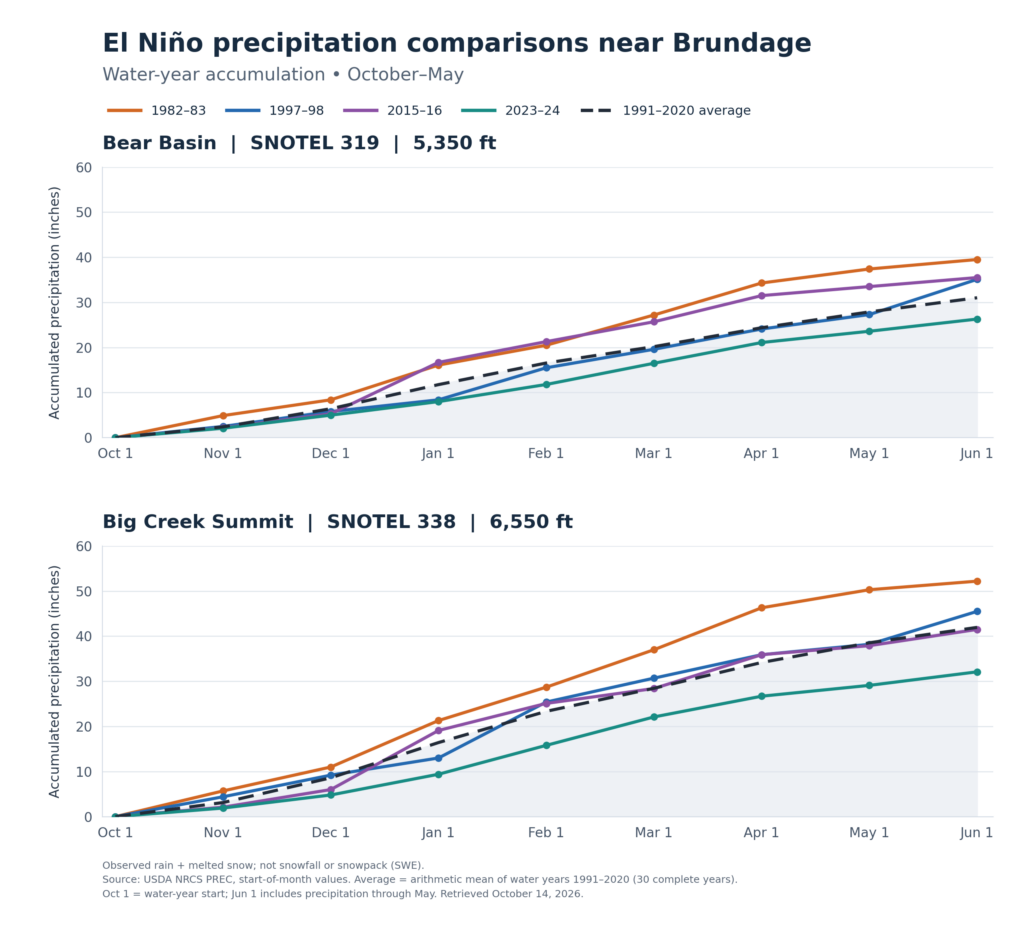
“This finding challenges the assumption that a strong El Niño necessarily means a dry winter around Brundage,” Platt says.
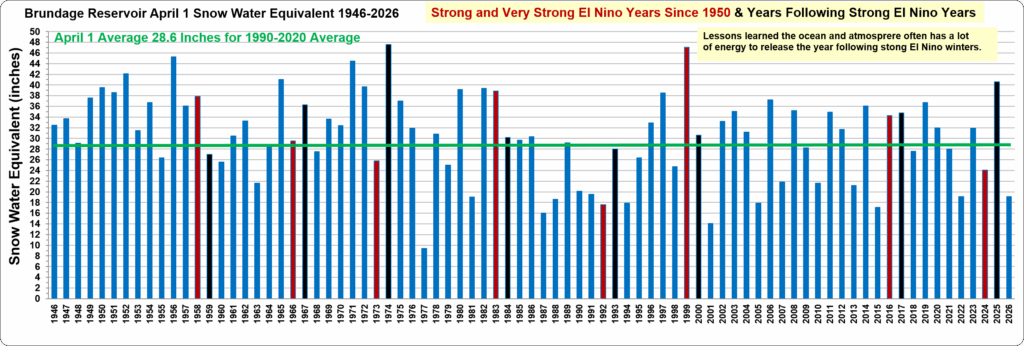
Abramovich’s review of the longer snowpack record at Brundage Reservoir also gives him reason to question a blanket prediction of a poor winter. He reports that most of the strong and very strong El Niño years he examined had near-normal or better conditions in the local record.
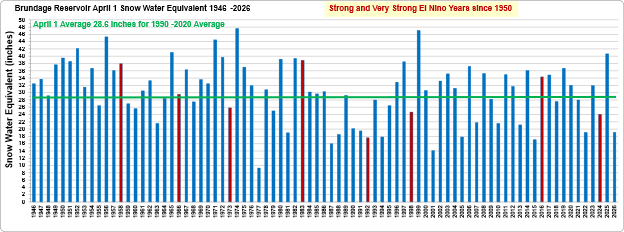
These measurements tell different parts of the winter story. Precipitation includes rain and snow. Snow water equivalent measures the water held in the snowpack. Neither is the same as the inches of fresh snowfall recorded at Brundage.
Still, both experts’ findings point toward the same useful conclusion: The local history is more encouraging than a broad “El Niño means dry” assumption would suggest.
A slow start doesn’t settle the season
One consistent finding in Platt’s analysis deserves attention: All four winters had below-average November precipitation.
That could make for some anxious early-season forecast checking. But what happened afterward matters just as much.
“All four winters had below-average November precipitation, but wetter periods during December through February demonstrate that conditions can improve rapidly,” Platt says. “A slow start does not necessarily mean a dry winter overall.”
Those historical results don’t predict opening day or guarantee a midwinter turnaround. They do offer a good reason to resist judging an entire ski season by what happens in November.
Brundage Mountain saw a good example of this during December 2015, when the week before Christmas delivered on ALL of our powder dreams:
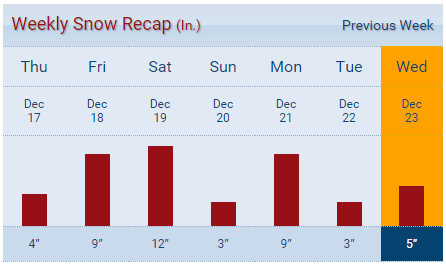
December 2015
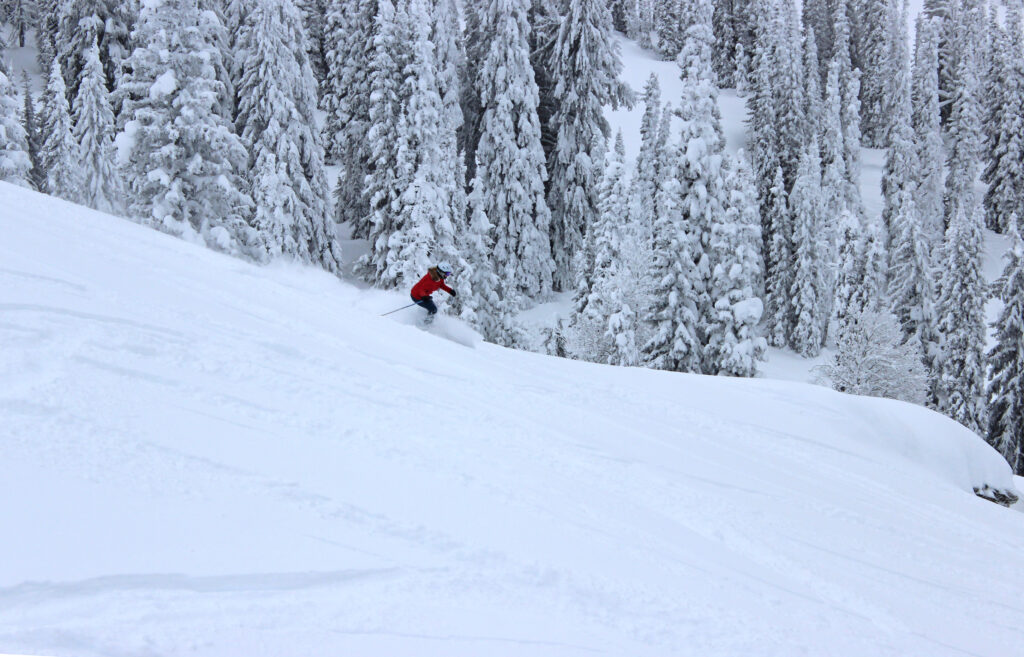
December 23, 2015
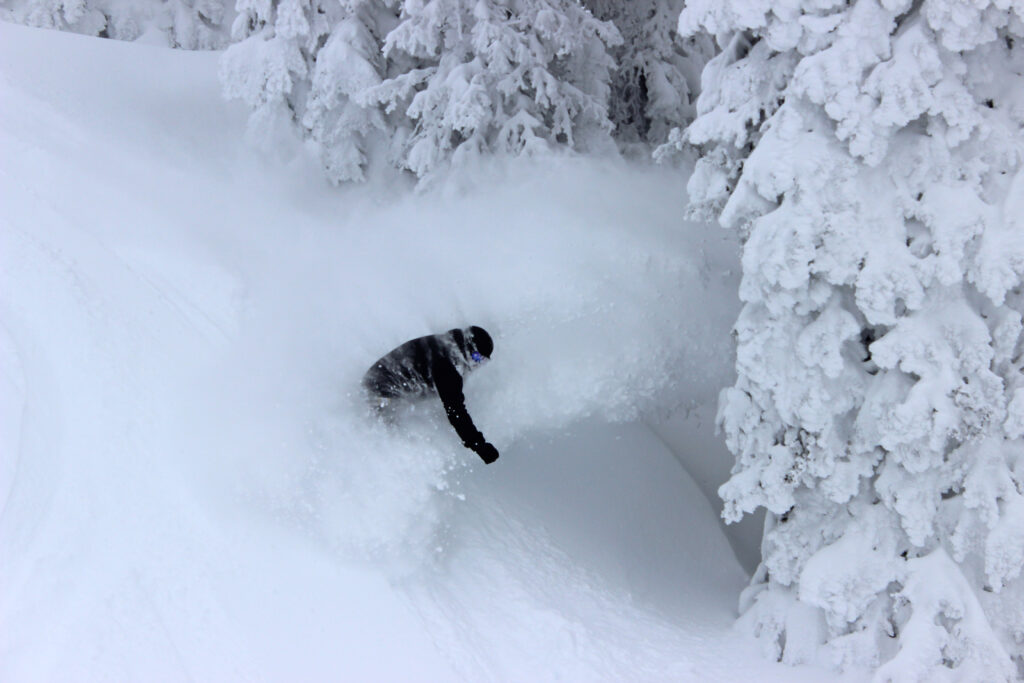
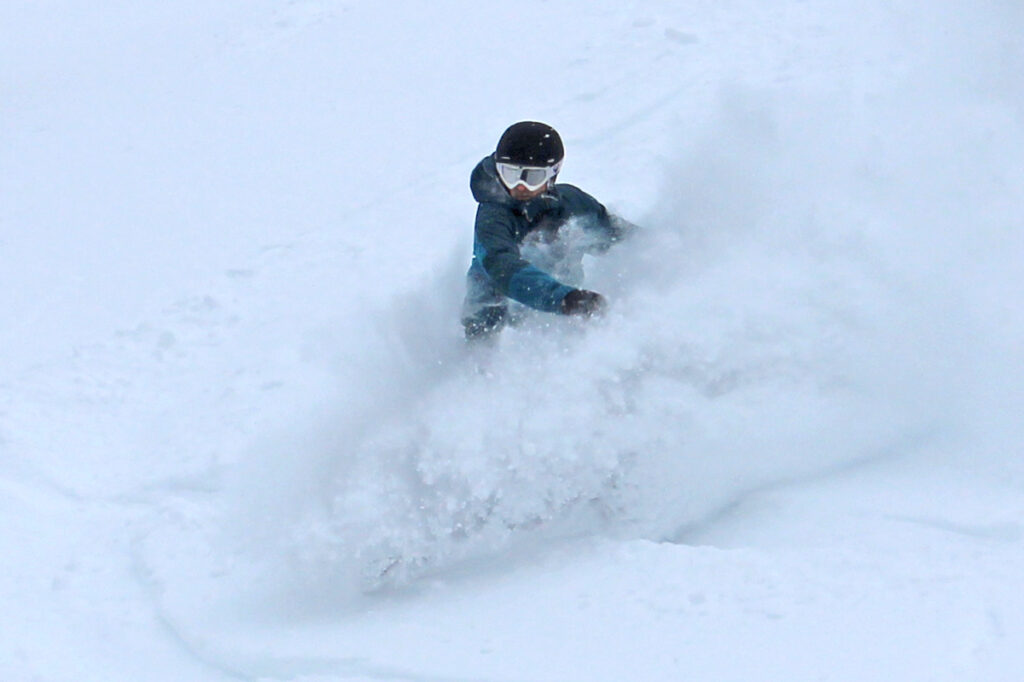
The Lesson: Winter has months to unfold, and the timing of its storms can make a big difference.
Where the storms go matters
Abramovich is watching whether storms following a more southerly El Niño track reach far enough north to deliver moisture to Idaho.
“El Nino storm tracks typically roll into southern California and across the desert southwest, but in strong El Nino events, like 1983, these storms pushed north bringing abundant moisture into Nevada and southern Idaho,” he says.
That example isn’t a promise for Brundage. It shows why the actual path of winter storms matters more locally than a simple regional label.
“Time will tell if this happens again this winter,” Abramovich says.
He’s optimistic about Idaho getting its share of storms. Platt’s assessment also leaves room for a good winter, with an important qualification about temperature.
Temperature is part of the picture
A winter can receive ample moisture and still pose challenges for skiers if too much of it arrives as rain.
Platt found a tendency toward warmer core-winter conditions in the available temperature records. That means the encouraging precipitation findings need to be considered alongside the temperatures that determine how that moisture falls.
His conclusion balances both:
“Although the available temperature records show a tendency toward warmer core-winter conditions, a strong El Niño alone is insufficient reason to expect a poor snow season at Brundage.”
Keep watching the forecast and leave room for winter
Neither expert can tell us how many powder days await. Their local perspective does help put the headlines in context.
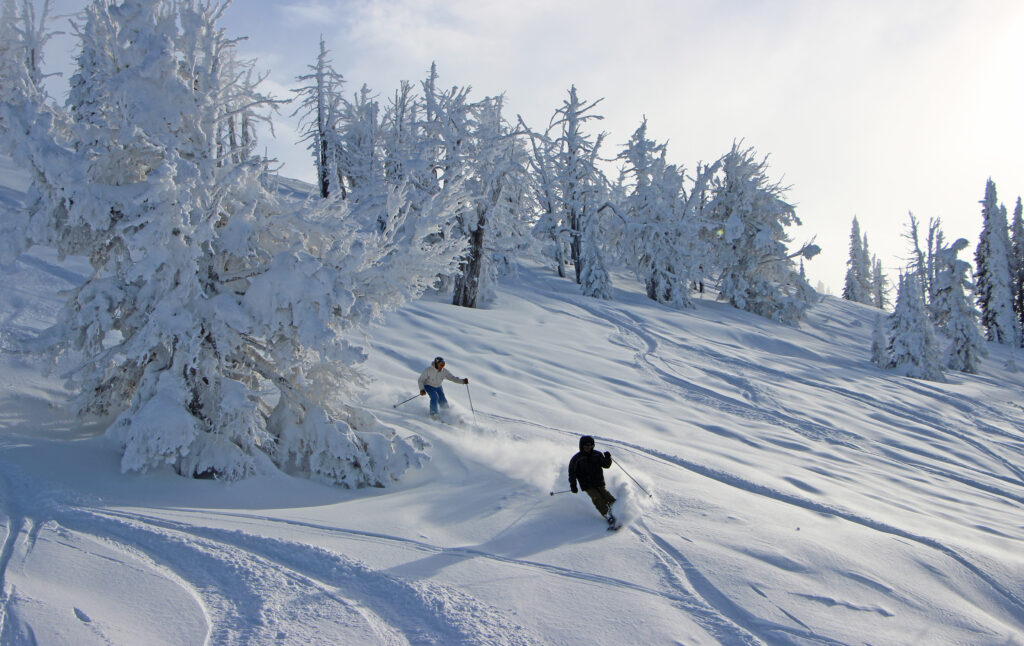
January 2026
Strong El Niño winters have delivered meaningful moisture around Brundage. A dry (or too warm to accumulate) November hasn’t always carried through the season. And the storm tracks and temperatures that develop over the coming months will help determine what we actually ski.
Abramovich, for one, plans to be here for it.
“I got my Brundage pass and looking forward to chasing El Nino storms to Brundage.”
And there’s more.
“For those thinking about the year after a Super El Nino event, I’ve learned the oceans and atmosphere have a lot of energy to release in the years following strong El Ninos,” Abramavich says. “Sometimes the year following is even better than the strong El Nino winter. I’ll be buying my Brundage ski pass again for the 2027-28 season to continue enjoying some of the best snow around.”